

- 152 Views
- 17 Min Read
- (31) Comments
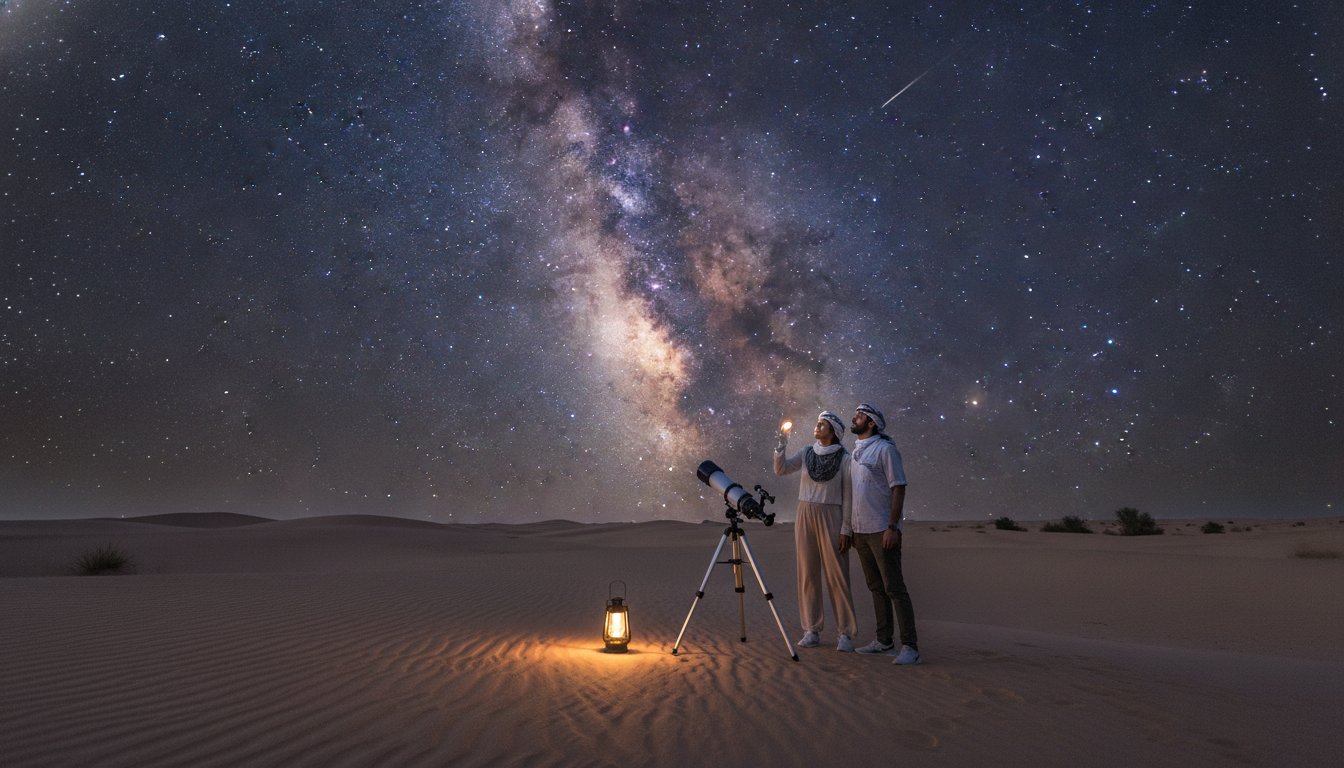
What if the most breathtaking view in the United Arab Emirates isn’t found at the top of a skyscraper, but in the absolute darkness of the Empty Quarter? While the vibrant lights of the city are iconic, they often act as a veil, hiding the ancient celestial tapestry that has guided Bedouin travelers for centuries. Booking a professional star gazing desert safari Abu Dhabi experience is the only way to pierce through that urban glow and reconnect with the vastness of the cosmos.
It’s frustrating when light pollution or a lack of specialized equipment stands between you and a clear view of the Milky Way. You shouldn’t have to worry about desert safety or missing out on the perfect shot because you don’t have a telescope. This guide will show you how to escape the city lights and witness the stars with confidence. We’ll preview the best locations for 2026 celestial events, share expert tips for smartphone astrophotography, and help you find a peaceful, cultural journey that stays with you long after the sun comes up.
Key Takeaways
- Understand how the low humidity and distance from urban light pollution create the perfect “seeing” conditions for deep-space observation in the Al Khatim desert.
- Plan your journey around the 2026 celestial calendar to catch the Milky Way core at its peak or witness the spectacular Perseid meteor shower in mid-August.
- Master simple smartphone astrophotography techniques, including how to use sand dunes as natural tripods for crisp, long-exposure night sky shots.
- Learn why timing your trip with the lunar cycle is essential for escaping moon glare and ensuring the darkest possible skies for your adventure.
- Discover why an Overnight Desert Safari is the premier choice for a star gazing desert safari Abu Dhabi, offering a peaceful night under the stars far from the city.
Why the Abu Dhabi Desert is a Premier Stargazing Destination
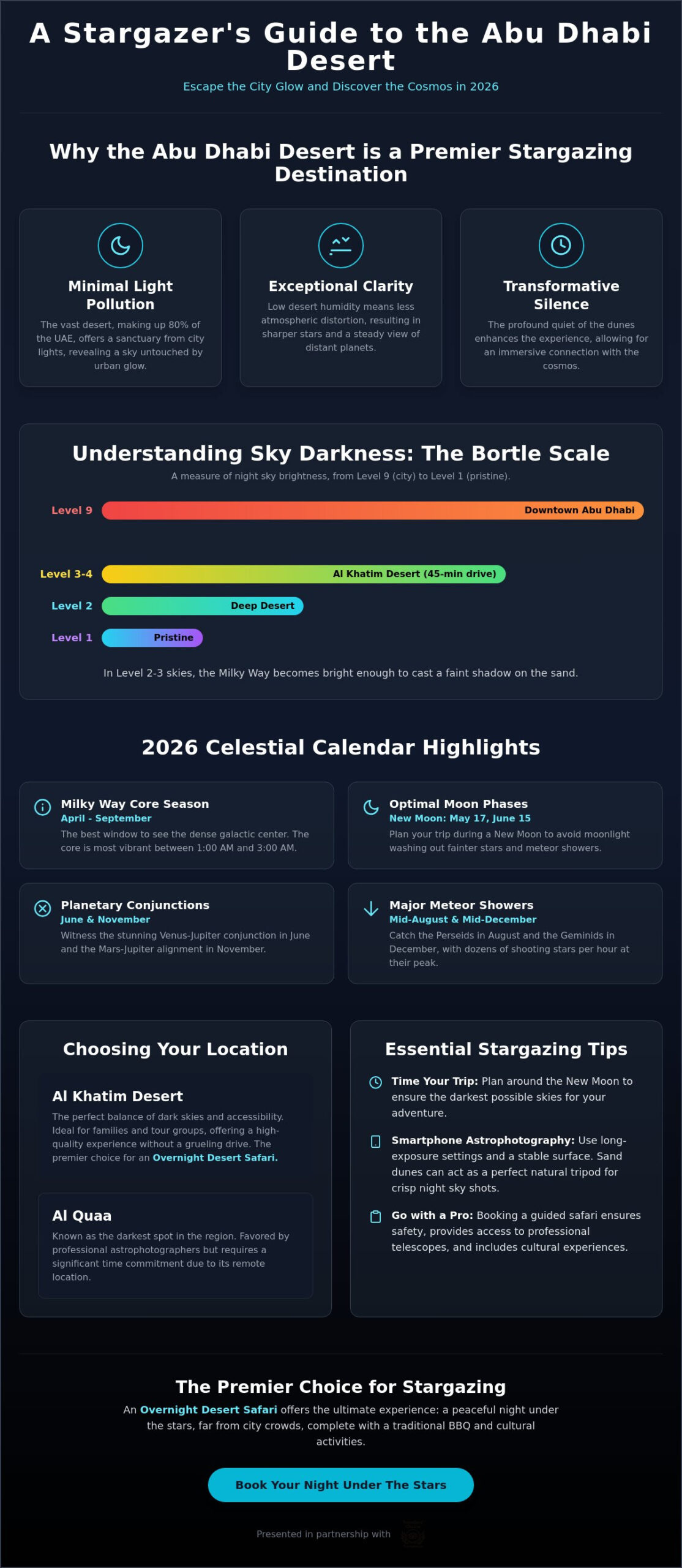
Step away from the glowing skyline of the city and you’ll quickly realize that the true magic of the Emirates happens after dark. The Abu Dhabi desert isn’t just a place for adrenaline; it’s a sanctuary for those who seek a connection with the cosmos. Because the desert makes up 80% of the UAE’s total land area, you don’t have to travel far to find vast, uninhabited stretches where the sky remains untouched by modernization. The primary obstacle to seeing the stars is light pollution, which is the excessive or misdirected artificial light produced by urban centers. In the dunes, this glow fades, revealing a celestial display that feels close enough to touch.
Atmospheric clarity is just as vital as darkness. The desert’s low humidity creates perfect “seeing” conditions for telescopes and cameras alike. Without heavy water vapor to distort the light, stars appear sharper and don’t twinkle as violently, allowing you to see the steady glow of distant planets. When you combine this clarity with the absolute silence of the dunes, the experience becomes transformative. It’s a rare chance to hear nothing but the wind while looking at light that has traveled for thousands of years to reach your eyes.
Understanding the Bortle Scale in the UAE
Astronomers use the Bortle Scale to measure the darkness of the night sky, ranging from Level 9 (inner-city sky) to Level 1 (pristine dark sky). While downtown Abu Dhabi sits at a Level 9 where only the brightest planets are visible, a 45 minute drive into the dunes can bring you to a Level 3 or 4. If you venture into the deep desert, you’ll experience Level 2 conditions. At this level, the Milky Way is so bright it can cast a faint shadow on the sand. You won’t just see a few constellations; you’ll witness the intricate, cloudy structures of our galaxy’s core stretching from horizon to horizon.
Al Khatim vs. Al Quaa: Choosing Your Spot
Your star gazing desert safari Abu Dhabi journey depends on finding the right balance between darkness and accessibility. Al Quaa is famous among professional astrophotographers for being the darkest spot in the region, but its remote location requires a significant time commitment. For most visitors, the Al Khatim desert offers the perfect middle ground. It provides stunningly dark skies and towering dunes while remaining easily accessible for an Overnight Desert Safari. This area allows you to enjoy a traditional BBQ dinner and cultural activities before settling into the quiet darkness for a professional viewing session. It’s the ideal choice for families and travelers who want a high-quality stargazing experience without the grueling drive of the deep desert.
What You Can See: A 2026 Celestial Calendar for Abu Dhabi
The night sky over the UAE promises a series of rare spectacles throughout 2026. To get the most out of your star gazing desert safari Abu Dhabi, you should sync your visit with the celestial clock. Unlike the city where the sky often appears as a flat, hazy gray, the desert offers a front-row seat to the planetary dance. In January 2026, Jupiter will be at its brightest, dominating the eastern horizon for most of the night. Later in the year, look for the stunning Venus-Jupiter conjunction in June and the Mars-Jupiter alignment in November. These moments create a brilliant, jewel-like effect against the velvet blackness of the dunes.
Meteor showers are the true highlights for many visitors. The Perseid Meteor Shower in mid-August and the Geminid Meteor Shower in mid-December will be the major events of the year. During these peaks, you can often see dozens of “shooting stars” per hour streaking across the dark sky. For the most accurate timing on these and other celestial events for Abu Dhabi, it’s best to consult local experts. Remember that the moon is your biggest rival for visibility. A full moon, like the one expected on December 24, 2026, can wash out the fainter stars. Aim for the New Moon windows on May 17 or June 15 to ensure the deepest darkness possible.
The Milky Way Core Season
The galactic center is the most sought-after sight for any stargazer. In Abu Dhabi, the best viewing window runs from April to September. This is when the densest part of our galaxy rises high above the horizon. You’ll be able to spot the “Great Rift,” a massive dark cloud of interstellar dust that appears to split the Milky Way in two. Between 1:00 AM and 3:00 AM during these months, the core is at its most vibrant. Booking an Overnight Desert Safari provides the stillness and time needed to truly appreciate the scale of our galaxy without rushing back to the city.
Ancient Wisdom: Bedouin Star Navigation
For centuries, the night sky wasn’t just beautiful; it was a vital survival tool. Long before modern technology, Bedouin tribes navigated the shifting Al Khatim dunes using the stars. They relied heavily on Al Jaddi, the North Star, as a fixed point for orientation across the trackless sands. Other constellations signaled the changing seasons, the arrival of rain, and the best times for grazing. By learning these ancient patterns during your star gazing desert safari Abu Dhabi, you connect with a heritage that dates back thousands of years. It transforms your journey from a simple tour into a deep cultural encounter with the desert’s timeless history.
How to Prepare for Your Star Gazing Desert Safari
Prepare for your journey by looking beyond the weather forecast. While the sun remains a constant force in the UAE, the night requires a different kind of readiness. A successful star gazing desert safari Abu Dhabi starts with timing. Always check the lunar cycle before you book your trip. A bright full moon can wash out the Milky Way, turning a deep-space viewing session into a brightly lit landscape tour. Aim for the “New Moon” phase for the darkest skies. This simple step ensures the celestial core remains the star of the show.
Pack your bags with the desert’s extreme temperature shifts in mind. Even if the daytime heat reaches 40°C, the sand loses its warmth rapidly once the sun sets. Temperatures in the dunes can drop significantly, often reaching a crisp 15°C or lower during the winter months. Bringing a red-light flashlight is another expert move. Unlike standard white light, red light allows you to see your surroundings without resetting your eyes’ natural adjustment to the dark. Finally, decide on your level of immersion. While an evening tour offers a taste of the stars, choosing an Overnight Desert Safari ensures you have hours of uninterrupted darkness to witness the rotation of the cosmos.
Clothing and Comfort Essentials
Dress in layers to stay comfortable as the environment changes. Lightweight cotton is perfect for the early evening activities, but you’ll want a fleece or wool jacket once the stars come out. Don’t forget your feet. While sandals are fine for the camp, closed-toe shoes are much better for navigating soft sand in the dark where visibility is low. If you’ve booked an overnight desert camping Abu Dhabi experience, bring a clean pair of warm socks. Keeping your extremities warm is the key to a restful night under the stars.
Managing Your Night Vision
Give your eyes the time they need to adapt. It takes approximately 20 to 30 minutes for human eyes to fully adjust to the dark and reach peak sensitivity. This is when the faintest nebulae and star clusters suddenly become visible to the naked eye. Avoid the “white light” mistake. One quick glance at a bright smartphone screen or a standard flashlight can instantly ruin your night vision, forcing your eyes to restart the adjustment process. If you must use a phone for navigation or apps, enable “Night Mode” or use a red-light filter to keep your vision sharp and the stars bright.
Capturing the Cosmos: Smartphone Astrophotography Tips
Bringing home a piece of the night sky is easier than you might think. You don’t need expensive professional gear to document your star gazing desert safari Abu Dhabi experience. Modern smartphones come equipped with powerful sensors that can capture distant galaxies if you know how to unlock their potential. The most critical factor is stability. Because your phone needs to keep the shutter open for several seconds to gather light, even the slightest hand tremor will result in a blurry mess. Use a portable tripod or lean your phone against a firm object. In the Al Khatim dunes, the sand itself makes a perfect, adjustable mount for your device.
Start by disabling your flash. It’s a common mistake that only succeeds in overexposing the sand right in front of you while washing out the distant stars. Instead, rely on “Night Mode” or “Pro Mode.” These settings allow you to push the exposure time to its maximum, usually between 10 and 30 seconds. This duration is long enough to pull in the faint glow of the Milky Way without causing the stars to trail due to the Earth’s rotation. If you want to ensure your photos look as professional as possible, book an Abu Dhabi Private Desert Safari to get away from camp lights and find the darkest, most serene shooting spots.
iPhone and Android Settings for Stars
Mastering your focus is the secret to crisp celestial images. In pitch darkness, your phone’s auto-focus will often struggle. Switch to manual focus and set it to “Infinity” or just slightly before it to ensure the distant stars stay sharp. Use the self-timer function set to 2 or 5 seconds. This prevents the “camera shake” that happens when you physically tap the screen to take the photo. When it comes to editing, less is more. Slightly increase the contrast and pull down the blacks to make the Milky Way “pop” against the dark sky, but avoid over-saturating the colors to keep the image feeling authentic.
Top Constellation Apps
Navigate the deep space above you with the help of technology. Apps like SkyGuide and Stellarium are essential companions for any desert adventure. These tools allow you to download star maps for offline use, which is perfect for areas with limited mobile reception. From our specific latitude in the UAE, you can easily locate the Southern Cross near the horizon or the prominent belt of Orion during the winter months. These apps overlay the names and shapes of constellations directly onto your camera view, making it simple to identify exactly what you’re seeing in real-time. It’s like having a professional astronomer standing right beside you in the dunes.
Booking Your Night Under the Stars with Desert Heritage Abu Dhabi
Select an experience that honors both the high-octane thrill of the dunes and the spiritual stillness of the stars. While many visitors opt for a quick evening trip, the true magic of a star gazing desert safari Abu Dhabi reveals itself long after the day-trippers have departed. By staying overnight, you give yourself the gift of time. You’ll watch the sky transform as the city’s distant glow fades and the galactic core begins its slow crawl across the velvet sky. Our professional guides act as your local hosts, sharing stories of the sands and ensuring your safety so you can focus entirely on the horizon.
Our camp in Al Khatim serves as your private observatory. After an evening of traditional hospitality, including a gourmet BBQ dinner and a crackling bonfire, we dim the camp lights to prioritize the celestial view. It’s a seamless transition. You move from the high-energy excitement of an Abu Dhabi Desert Safari into the profound midnight silence of the dunes. You’ll sleep in comfortable private tents designed to provide a sense of security without disconnecting you from the environment. Waking up is just as spectacular. You’ll witness a golden sunrise over the dunes followed by a fresh traditional breakfast before we head back to civilization.
Our Overnight Camping Experience
The transition from sunset thrills to midnight silence is the heart of our overnight journey. Once the quad bikes are parked and the music fades, the desert returns to its natural state. This is when the Al Khatim dunes truly shine. Our tents are positioned to offer privacy and a clear view of the horizon, allowing you to step out and see the stars the moment you wake up. It’s a rare opportunity to experience the desert as the Bedouin have for generations, wrapped in a blanket of silence that you simply can’t find anywhere else in the Emirates.
Plan Your Visit
Planning your visit requires a quick look at the calendar. The most comfortable weather for camping occurs between October and April when the evening air is cool and the skies are remarkably clear. If you’re traveling with a partner or seeking a dedicated photography session, an Abu Dhabi Private Desert Safari offers the seclusion you need to set up your tripod without interruption. For those who enjoy a social atmosphere, our shared tours provide a wonderful sense of community around the fire. With the 2026 celestial calendar promising major meteor showers and planetary alignments, your star gazing desert safari Abu Dhabi will be the highlight of your travels. Book your overnight desert camping Abu Dhabi adventure today and witness the universe as it was meant to be seen.
Step Into the Infinite Beauty of the Night Sky
The desert is a place of transformation where the noise of the city is replaced by the eternal silence of the stars. You now have the tools to plan your journey, from selecting the perfect lunar phase to mastering the manual settings on your smartphone. True stargazing is more than just looking up; it’s about connecting with a timeless landscape that has guided tribes for centuries. By choosing a professional star gazing desert safari Abu Dhabi, you ensure that every detail is handled with local expertise and care.
Our expert guides lead you to the darkest, most serene spots in the authentic Al Khatim desert. You’ll enjoy a full BBQ dinner under the glow of the Milky Way and wake up to a traditional breakfast as the sun paints the dunes in gold. Don’t let the urban glow hide the universe’s most spectacular display from you. Book Your Star Gazing Overnight Safari today and experience the desert’s quiet magic for yourself. The stars are waiting to tell you their story.
Frequently Asked Questions
Can you see the Milky Way from Abu Dhabi?
You can absolutely see the Milky Way from Abu Dhabi if you travel deep enough into the dunes to escape urban light pollution. While the city sky is too bright for celestial viewing, the surrounding desert offers a clear window into the galactic core. For the most vivid experience, plan your trip during the peak season from April to September and choose a night with a New Moon when the sky is at its darkest.
What is the best month for stargazing in the UAE?
The best months for comfortable weather and clear skies are October through April, as the temperatures are much cooler for outdoor observation. However, if your goal is to see the densest part of the Milky Way, the summer months of April to September provide the best celestial positioning. During this time, the galactic center rises high above the horizon, offering a breathtaking view for any star gazing desert safari Abu Dhabi enthusiast.
Where is the darkest place in Abu Dhabi for stargazing?
Al Quaa is widely recognized as the darkest accessible spot in the emirate, sitting at a Level 2 on the Bortle Scale. It is located about 90 minutes from the city center and offers pristine conditions for astrophotography. For those seeking a balance between darkness and convenience, the Al Khatim desert provides excellent visibility while remaining close enough for a comfortable overnight stay at a professional camp with full amenities.
What should I wear for a night desert safari?
Dress in versatile layers to handle the desert’s rapid temperature shifts once the sun sets. While lightweight cotton is ideal for the afternoon, you’ll need a warm fleece or a medium-weight jacket once the sand cools down significantly at night. Wear closed-toe shoes to navigate the soft dunes safely in the dark. Don’t forget a pair of warm socks if you plan to stay overnight, as the ground temperature can drop much lower than the air.
Is it safe to go stargazing in the desert alone?
Venturing into the deep desert alone at night is not recommended due to navigation challenges and safety risks. Shifting dunes can make it easy to lose your way, and mobile reception is often unreliable in remote areas. Booking a guided star gazing desert safari Abu Dhabi ensures you have an expert driver and a secure camp environment. This allows you to enjoy the stars with total peace of mind and professional support.
Do I need a telescope for a stargazing safari?
You don’t need a telescope to appreciate the beauty of the desert sky. The naked eye is often enough to see major constellations, planets, and the cloudy band of the Milky Way in a dark-sky location. Many guests find that a simple pair of binoculars or a modern smartphone with “Night Mode” is more than sufficient for a rewarding experience. Professional guides can also help point out specific celestial landmarks using specialized equipment and laser pointers.
How much does an overnight desert safari in Abu Dhabi cost?
The cost of an overnight desert safari depends on the specific package and inclusions you select for your group. Rates generally differ between shared camp experiences and a private desert safari which offers more exclusivity. Most reputable operators include the mandatory 5% VAT in their pricing and provide a clear breakdown of what is covered, such as meals and activities. It’s best to check current seasonal rates directly with your tour provider to get an accurate quote.


Comments (31)
jeetbuzzdownloadapk,
09 September, 2026The APK installation was a breeze. I was worried about the setup but it worked perfectly on my Android phone. Great experience so far. Get it at jeetbuzzdownloadapk
krevoplay,
09 September, 2026Absolutely loving the gameplay here. The graphics are sharp and the winning streaks are real. Join krevoplay
20jililogin,
09 September, 2026The login process is seamless and I had no issues setting up my account. It feels very secure and professional. I prefer using 20jililogin for my daily gaming.
krikia11,
09 September, 2026Great platform with very fair odds. I appreciate the transparency and the quick customer support. krikia11 is a winner.
168jililogin,
09 September, 2026Login is fast and the games start instantly. No lagging or crashes which is exactly what I need when gaming. 168jililogin makes everything so effortless.
phpgophilippines,
09 September, 2026Really enjoying the vibe here. Everything is localized perfectly and the withdrawal process is super quick. Visit phpgophilippines for a great time.
idmahesa189,
09 September, 2026Really impressed with the customer service and the fast withdrawal process. It feels safe and professional. Glad I joined idmahesa189 for my daily gaming.
sunwin89,
09 September, 2026The graphics are stunning and the gameplay is super addictive. It is definitely my new favorite spot to relax after work. Visit sunwin89 for a great experience.
phtopwinph,
09 September, 2026Best platform I have found so far in the Philippines. The games are fair and the interface is very user-friendly. Highly recommend phtopwinph
10brlcassino,
09 September, 2026A hidden gem for casino lovers. The promotions are generous and the gameplay is very rewarding. I’m definitely sticking with 10brlcassino
br898bet33,
09 September, 2026Great vibes and a very stable platform. I have tried many others but this one feels more secure and professional. Join br898bet33
vngamef188,
09 September, 2026I’ve been playing here for a few weeks now and the interface is super smooth. Really enjoying the variety of games available. Check out vngamef188 for a great experience!
888winbetapp,
09 September, 2026The app version is just a game changer. I can place my bets anywhere and the payouts are processed quickly. Give 888winbetapp a try if you want a stable platform.
pkbitpkr,
09 September, 2026Fast transactions and a very secure feeling. It is hard to find sites this trustworthy these days. pkbitpkr is a total gem.
betjiliapk,
09 September, 2026The app is super responsive and doesn’t lag at all. It makes gaming so much easier on the go. Highly recommend downloading betjiliapk
iddewi1000,
09 September, 2026I am impressed with the registration process, it was so quick. The game selection is fantastic. Head over to iddewi1000.
7888wingame,
09 September, 2026Honestly the best gaming experience I’ve had in a while. The graphics are crisp and the winning streaks have been amazing lately. 7888wingame is definitely my new go-to site.
lancar138slot,
09 September, 2026If you are into slots then this is where you need to be. The graphics are great and the winning streaks are real. Give lancar138slot a try and see for yourself.
ph55vip777,
09 September, 2026Feeling like a total VIP here. The rewards program at ph55vip777 is honestly the best in the market.
phjili178,
09 September, 2026Best local platform for Jili fans. The promotions are tailored perfectly and the community is great. I’m sticking with phjili178 for sure.
22jiliapps,
09 September, 2026The app version is so convenient. I can play anywhere and anytime without any hiccups. Download 22jiliapps for the best mobile gaming.
idsolusiwin,
09 September, 2026If you are looking for a real solution to win more often, this is the place. The tips and the platform are top notch. idsolusiwin is a hidden gem.
393betlink,
09 September, 2026I’ve tried a few sites lately but this one really stands out for its smooth interface. Highly recommend checking out 393betlink if you want a hassle-free experience.
phokbetupdate,
09 September, 2026I always check here for the latest promos and game updates. It keeps me in the loop so I never miss a big jackpot opportunity. Thanks to phokbetupdate for the info.
cwdbetslot,
08 August, 2026The bonus offers are actually worth it compared to other sites I have used. The slots are fair and the excitement is real. Give cwdbetslot a go if you love slots.
dremjilislot,
08 August, 2026The slots here are so addictive and the themes are really cool. I had a blast winning a few big pots last night. Check out dremjilislot today.
idgg189,
08 August, 2026Super impressed with the fairness of the games here. I feel like I actually have a chance to win. Really happy with idgg189 so far.
phjilibett,
08 August, 2026If you are looking for a fair and honest gaming site, phjilibett is the way to go. Five stars from me!
xojilicasinologin,
08 August, 2026Really impressed with the customer service and the overall vibe of the site. It is easy to navigate and very rewarding. Visit xojilicasinologin soon.
idsgcvip,
08 August, 2026The VIP treatment here is on another level. I feel valued as a player and the rewards are generous. Highly suggest joining idsgcvip.
jili188login,
08 August, 2026Finally found a site that does not lag during the big wins. The interface is very user friendly and the payouts are legit. Love jili188login so much!